By Matthew B. Harrison
TALKERS, VP/Associate Publisher
Harrison Legal Group, Senior Partner
Goodphone Communications, Executive Producer
 For years, Harrison Legal Group has informed media creators about the legal risks of using copyrighted clips, songs, images, and broadcasts without permission. The issue became central enough to inspire my book, Playing the Clip: The Definitive Digital Media Creator’s Guide to Fair Use (TALKERS Books, 2026). The premise was straightforward: modern media runs on borrowed material, but borrowing comes with legal exposure.
Now the fight is shifting toward something more personal.
The voice itself.
Not the recording. Not necessarily the script. The identity embedded in the sound.
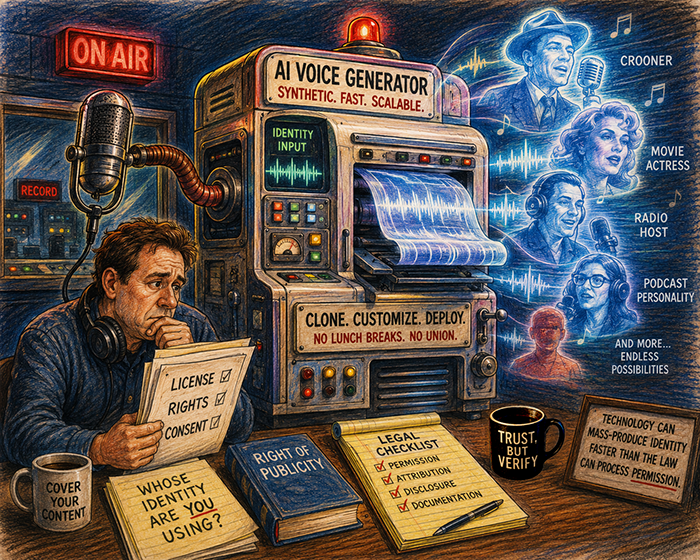
That distinction is becoming increasingly important as AI voice systems improve to the point where listeners can recognize a performer even when the company insists it used a “different actor” or synthetic generation. The Scarlett Johansson dispute with OpenAI may become the defining example. Johansson alleged that OpenAI created a voice assistant that sounded “eerily similar” to her after she declined the company’s request to license her actual voice. OpenAI denied intentionally imitating her and stated the voice belonged to another actress but still paused what they branded the “Sky” voice after backlash intensified.
The case matters because it exposes a legal gray area many creators misunderstand.
A voice is generally not protected by copyright law in the same way a song recording is. But a recognizable voice may still trigger claims involving the right of publicity, false endorsement, unfair competition, or misappropriation of identity. In other words, the legal risk is often not “you copied audio.” The risk is “you exploited identity.”
That distinction matters for broadcasters, podcasters, advertisers, and AI companies experimenting with synthetic hosts, cloned announcers, or celebrity-style narration.
If listeners reasonably believe a celebrity endorsed, participated in, or authorized the content, the legal exposure changes dramatically.
Read more….
Another recent example involves Dua Lipa and Samsung. According to reports, Lipa alleges Samsung used her image on television packaging without authorization, creating the impression she endorsed the product. Samsung reportedly claims the image came from a third-party provider that assured the company all rights were cleared.
That defense may sound familiar to media professionals.
“We got it from somebody else.”
Legally, that is often not enough.
A broadcaster cannot avoid defamation liability merely because a guest made the statement. A publisher cannot automatically avoid infringement exposure because a freelancer supplied the material. And a company may not avoid publicity-rights claims simply because a vendor promised the paperwork existed.
The underlying legal theme is the same: delegation is not immunity.
The AI layer complicates things further because modern systems do not necessarily reproduce exact copies. Instead, they generate approximations that may still evoke a specific person strongly enough to create marketplace confusion.
Courts have dealt with similar issues before. Bette Midler and Tom Waits both successfully sued over soundalike performances used in advertising after declining to participate themselves. The principle is not new. AI simply makes imitation faster, cheaper, and easier to distribute.
That should concern media creators who assume these disputes only affect billion-dollar tech companies.
They do not.
A local station, podcast producer, YouTube creator, or advertiser can now generate celebrity-adjacent voices in seconds. The barrier to entry collapsed. The liability did not.
The safest question is no longer merely “Do we own the audio?”
It is: “Whose identity does this remind people of?”
That answer may determine whether the next lawsuit is really about technology at all.
Or simply old-fashioned commercial exploitation wearing futuristic clothing.
Get your copy of “Play the Clip: The Definitive Digital Media Creator’s Guide to Fair Use” by filling out the request form at HarrisonMediaLaw.com.
Matthew B. Harrison is a media and intellectual property attorney who advises radio hosts, content creators, and creative entrepreneurs. He has written extensively on fair use, AI law, and the future of digital rights. Reach him at Matthew@HarrisonLegalGroup.com or read more at TALKERS.com.




 would be retiring from daily talk show hosting later this summer on Jacobs Media’s WDUN-AM/FM, Gainesville, where she presided over a hugely popular midday program since 2019. The decision was made due to heart-related health issues. She planned to remain with the powerful station as an occasional political consultant and commentator. Zoller, the 2023 recipient of the TALKERS “Woman of the Year” award, was an influential figure in Georgia politics having run for Congress in the U.S. 9th District as a Republican in 2012. Before that she served her first stint as a radio talk show host in North Georgia for a number of years. She was also a member of the State Board of Education representing District 9 in Northeast, Georgia in addition to engaging in a number of other community-oriented activities.
 and media personality Jason Jackson Jr. as its first client. Salem Media CEO David Santrella states, “For years, we’ve worked alongside some of the most influential voices in media. Many of them are looking for more than platform monetization. They want a partner who not only understands their audience and shares their values but also has the experience to help them continue building their brands. Launching SCA is a natural next step for us.” SCA managing director Andrew Samalot adds, “As we’ve worked alongside creators over the last several years, we’ve seen firsthand that the most successful talent aren’t just building social media audiences – they’re building brands, businesses, and platforms that extend far beyond any single channel. Our role is to help them identify those opportunities, navigate them strategically, and surround them with representation they can trust as they continue growing their influence and impact.”
 Congressional District. Flint is host of the morning drive show “Montana Talks” heard across Townsquare Media news/talk stations in Montana, including KBUL, Billings and KMMS, Bozeman. Flint took leave of his radio show to run for office. According to the Associated Press, Flint will face the winner of the four-way race in the Democratic primary. Flint’s campaign says he is emphasizing “making the Montana dream affordable again,” by reducing regulatory burdens on building homes, encouraging trades education and boosting the U.S. timber industry.
 production, station imaging, promotional audio, and other broadcast content across multiple stations and digital platforms. The Assistant Production Manager works closely with Programming, Sales, Traffic, Promotions, and On-Air staff to ensure all production elements are completed accurately, creatively, and on schedule while maintaining Lotus Seattle Corp. quality standards and FCC compliance requirements. This position requires strong audio production skills, creativity, technical proficiency, and the ability to effectively manage multiple deadlines in a dynamic broadcasting environment.
 broadcasting is at its best when it informs, connects and serves the community. Our goal is to provide timely, relevant information that keeps the Spokane-Coeur d’Alene metropolitan area well informed, whether it’s breaking news, traffic slowdowns, severe weather or the stories shaping our region each day.” Nelson adds, “After more than 25 years in Spokane broadcasting, I’ve seen how important live and local news is when people need it most. News Radio KBNW is built to be present at the start and end of every weekday, delivering reliable information people can depend on, along with engaging and entertaining talk programs the rest of the broadcast day.” The two say the news staff will consist of Steve Wilke, Joe Paisley, Erich Ebel and Scott Carlon. Talk programs will include: Dave Ramsey, Mike Gallagaher, Lars Larson, and Armstrong & Getty.
  Jason Reddick’s The Complete Guide to AI Side Hustles is aimed at beginners trying to build passive income. But read it through a broadcaster’s lens and it suggests a blueprint for how radio talent and podcasters can leverage AI to expand their influence, diversify revenue, and stay indispensable in a media economy that rewards relevance and speed.
 listeners and spark meaningful conversations around mental well-being. Throughout the month, Beasley stations nationwide will deliver on-air PSAs, share informative and relatable online stories, and extend supportive messaging through Quu dashboard displays. Beasley chief communications officer Heidi Raphael says, “Mental health touches everyone in some way. If we can use our platforms – on-air, online, and in the car – to encourage even one person to check in, reach out, or take a moment for themselves, then we’re making a difference – and that’s what Community of Caring is all about.”
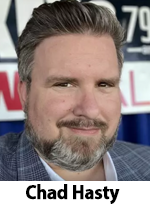 KFYO’s morning show. In 2021, ‘The Chad Hasty Show’ moved to late afternoons, where he continued informing and entertaining audiences across the region. Whether cutting through the news of the day or interviewing some of the most prominent political figures in the state and country, Chad always delivered an engaging and thought-provoking show for his loyal listeners.” Townsquare Media Lubbock market president Dan Endom adds, “We are stunned and heartbroken by the sudden passing of our beloved KFYO family member, Chad Hasty. Chad was not only a brilliant on-air host, but an even better friend. Our deepest condolences go out to [his wife] Jennifer and his baby girl, Ava. It’s hard to imagine not seeing his welcoming presence roaming the halls of Townsquare Media Lubbock.”
  2025. The company reports declines in all segments of its business; even digital revenue was off 8.3% ($33.5 million). Network spot revenue was down 25% ($33 million), and broadcast spot revenue was $67.7 million, a decline of 16.3% from Q1 of 2025. Cumulus president and CEO Mary G. Berner says, “We are pleased to report first quarter earnings. The Court’s recent approval of our reorganization plan marks a pivotal milestone in strengthening our financial foundation and positioning the company to compete in the evolving media landscape. While we await FCC approval of the plan, we remain focused on leveraging our core strengths to drive long-term value creation.”
 assumed the operations manager role at the company’s WMAL-FM, Washington. Cumulus regional vice president Larry Blumhagen states, “Art has proven to be exceptionally dedicated and creative in his years as APD for KABC. We are eager to watch him bring those qualities to the role of program director for KABC and KSFO.” Webb comments, “I’m excited to step into this role and build on the strong foundation already in place at both stations. Our focus remains on creating engaging, relevant content that truly connects with California listeners while continuing to elevate the incredible work of our talented teams. With such outstanding rosters in Los Angeles and San Francisco, I’m looking forward to sharing in much success together.”
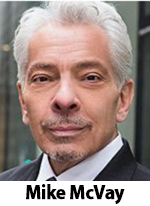 contributing their time, expertise, and resources. Honorees are true champions of service, demonstrating an unwavering commitment to fostering growth and progress within the industry.” McVay was presented with the award by Erica Farber on April 20, at the MIW Lipstick & Lobster Dinner at Maggiano’s. MIW board president Sheila Kirby states, “Mike McVay has been a consistent and powerful advocate for both the radio industry and the advancement of women within it. His willingness to share his time, expertise, and influence has made a lasting impact on MIW and the broader community we serve. Mike doesn’t just support the mission, he actively helps move it forward, and that kind of leadership is exactly what the Erica Farber Impact Award represents.”
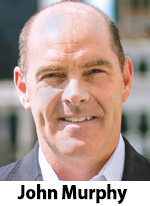 role with Crossover, Murphy will work to secure new content as well as to expand the company’s client portfolio. Crossover managing member Sue Freund says, “We’ve known and worked with John for many years; his excellent relationships throughout the content and advertising communities make him a tremendous addition to our team in building strategic partnerships with clients, agencies, and content providers as we continue to grow. He has a proven track record of building high-performing sales organizations, monetizing premium content, and delivering performance-driven advertising solutions for brands, agencies and media partners.” Murphy comments, “I’m excited to be joining Crossover Media Group. The team has built a strong reputation for delivering results-driven solutions for both creators and advertisers, and I look forward to contributing to that momentum. There’s a clear opportunity to unlock new growth across partnerships, and I’m eager to help scale the business while driving meaningful value for clients.”
 The rise of independent, talk show-style political commentary on YouTube has created a new class of media actors who do not see themselves as broadcasters, journalists, or publishers. They see themselves as creators. That distinction is real in terms of identity, tone, and platform. It is not real where it matters most: liability.
 news content, report on breaking news events, serve as board operator for special programming, and produce special projects and programming as assigned. This position does feature regular hours of board operator work, writing, producing, as well as anchoring newscasts. On occasion the position will offer extra hours during the week to cover shifts for those who are ill or on vacation.
  advertising market that was partially offset by the continued expansion of our high-margin, owned-and-operated direct digital revenues. Beasley recorded an operating loss of approximately $230.0 million in the fourth quarter of 2025, compared to operating income of $7.6 million in the fourth quarter of 2024, driven primarily by a non-cash FCC license impairment charge of $224.8 million, reflecting the company’s updated assessment of the fair value of its broadcast licenses in light of continued secular pressures on the radio industry, as well as $1.7 million in other operating expenses.”
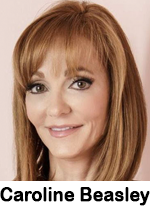 we made tangible progress reshaping this company for long-term value creation. Our digital business delivered record performance, with digital revenue representing approximately 24% of net revenue, up from roughly 19% of net revenue in 2024, and digital segment operating margins reached record levels as our continued shift toward owned-and-operated and programmatic products gained traction across our markets… Building on this progress, we recently announced a debt exchange transaction with our second lien bondholders, pursuant to which we expect to reduce our second lien debt by approximately 50% and repay roughly $15 million of our first lien debt. Upon completion of the transaction, which is subject to bondholder participation and expected to close by the end of April, we anticipate total outstanding debt will be reduced to approximately $110 million from $220 million today. We believe this transaction will meaningfully strengthen our balance sheet, enhance financial flexibility, and better position the Company to execute on its strategic priorities. Following its completion, our focus will shift toward further deleveraging through EBITDA growth and continued portfolio optimization.”